Course & textbook · INSA Toulouse, Applied Mathematics & Master Mod'IA - Scientific ML
Data Assimilation, Adjoint Methods and Learning
Inverse Problems for Physics-Based Models, from Optimal Control to Hybrid Machine Learning
How to fuse physics-based models (ODEs, PDEs) with observations? The course covers the estimation of model parameters, initial or boundary conditions and forcing terms; the computation of gradients in large dimension by the adjoint method; and the many bridges between data assimilation and machine learning.
Moodle, open access: login: anonymous pass: insa-assimilation
The course in three pictures
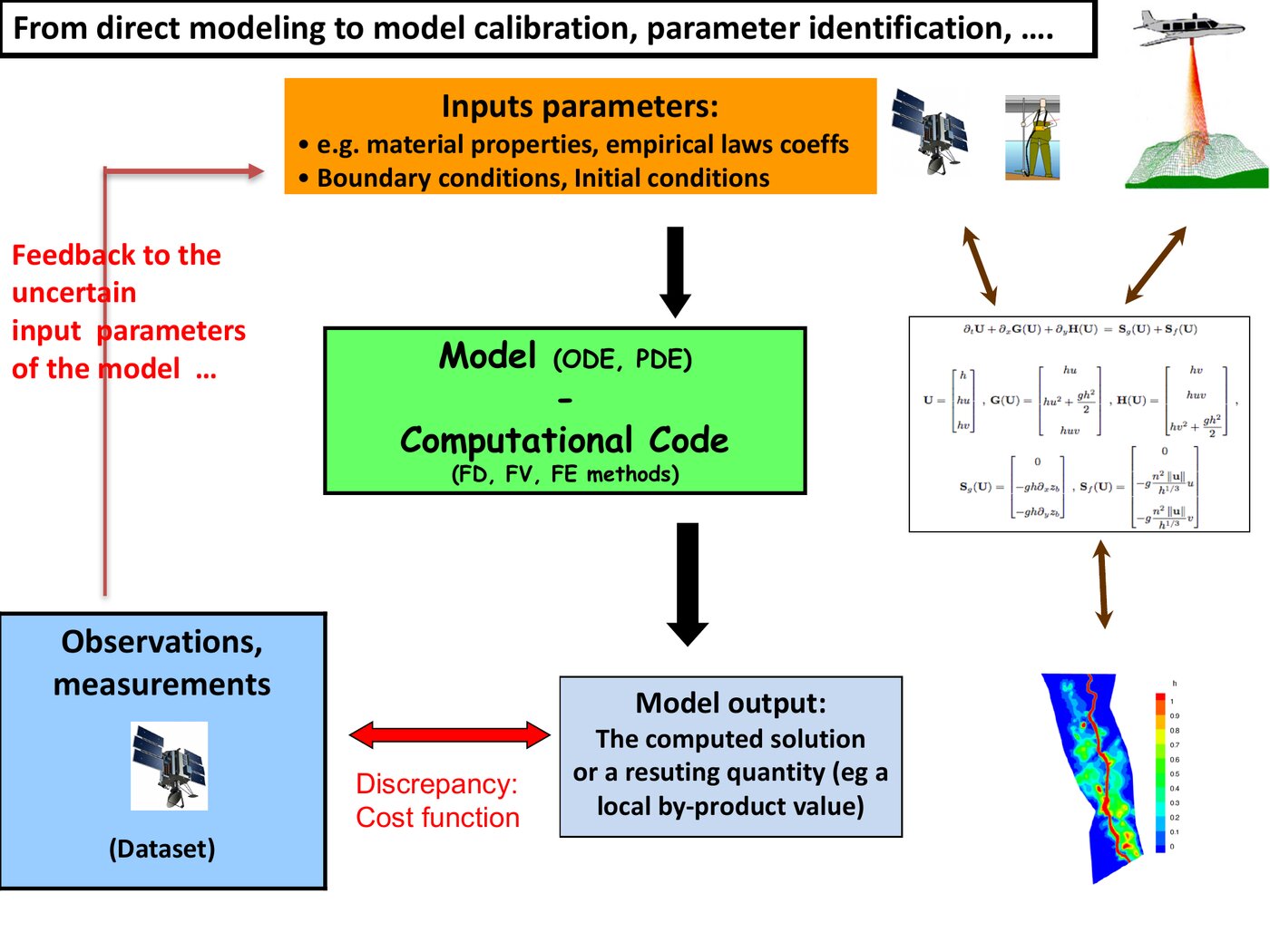
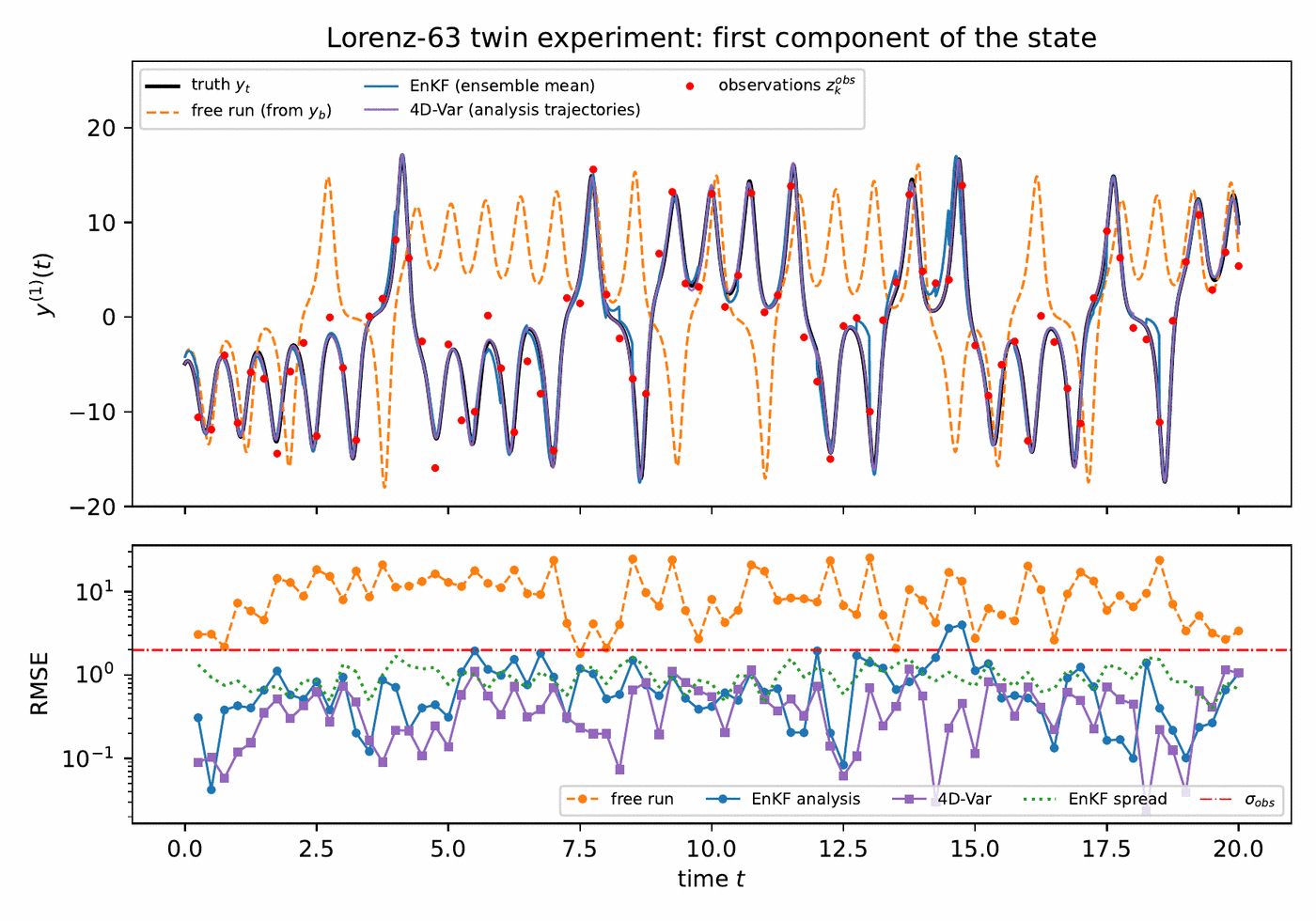
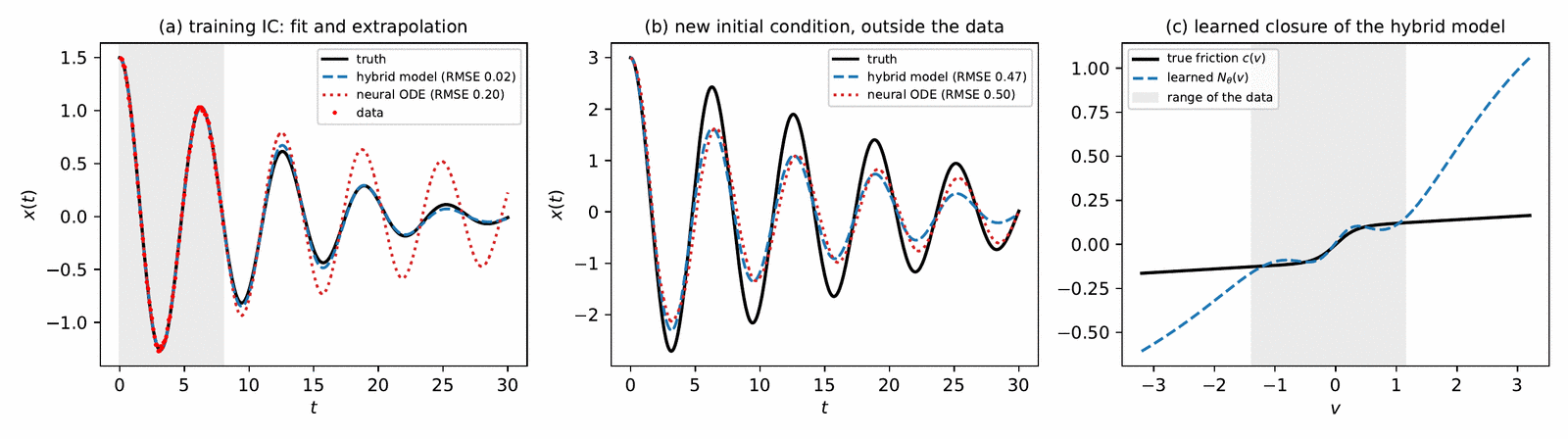
Contents
Ill-posedness; least squares, SVD, Tikhonov regularization, parameter choice; neural networks as parametric models; a running example: river bathymetry.
Overview of DA methods; VDA in finite dimension; optimal control of ODEs; PINNs, and PINNs vs VDA.
Backpropagation is the adjoint method; automatic differentiation; validating gradients and adjoint codes.
Optimal control of stationary PDEs; VDA for time-dependent PDEs: 4D-Var, incremental 4D-Var.
Bayesian inversion, MAP, sampling; BLUE, Kalman filters, ensemble methods; background error covariances.
Hybridizing data assimilation and machine learning. Appendices: differential calculus, optimization, statistics, solutions of the exercises.
Each chapter comes with exercises and Python codes; "learning corners" connect the topic to machine learning.
Practicals
River bathymetry from water-surface data
A real-world inverse problem in spatial hydrology, solved by VDA (Python, FEniCS finite elements).
Optimal control, adjoint and learning
Controlling a dynamical system, computing and validating the adjoint, and comparing with learning approaches (Python).
Statements, codes and course sessions are on the Moodle page. For research use in hydrology, see the open-source DassHydro platform.
How to cite
Jérôme Monnier. Data Assimilation, Adjoint Methods and Learning. Inverse Problems for Physics-Based Models, from Optimal Control to Hybrid Machine Learning. Lecture notes, INSA Toulouse, 2026. ⟨hal-03040047⟩
BibTeX
@misc{Monnier-DA-course,
  author       = {Monnier, J{\'e}r{\^o}me},
  title        = {Data Assimilation, Adjoint Methods and Learning.
                  Inverse Problems for Physics-Based Models,
                  from Optimal Control to Hybrid Machine Learning},
  howpublished = {Lecture notes, INSA Toulouse},
  year         = {2026},
  note         = {HAL: hal-03040047},
  url          = {https://hal.science/hal-03040047}
}
Prerequisites
Basic approximation methods, differential calculus, numerical optimization, classical PDE models (weak forms are a plus), numerical schemes (finite differences; finite elements are a plus), artificial neural networks, Python programming.
The textbook is a living document (October 2026 version), revised as the course progresses. Questions and feedback are welcome by e-mail.