Some numerical results of my research activity
Simulation of nanoscale MOSFETs :
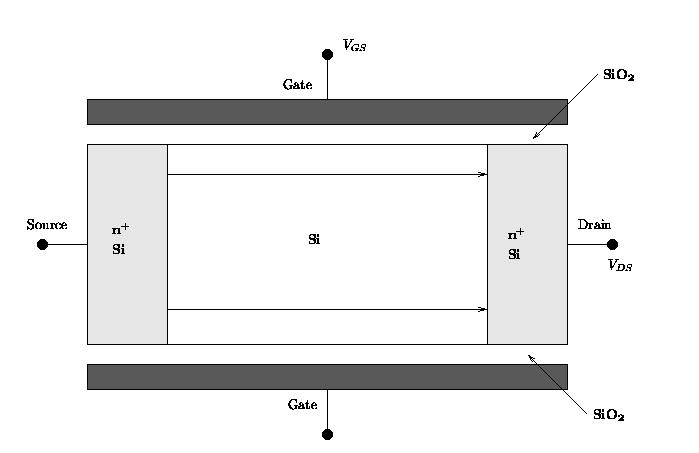
The WKB approximation was used to develop a model simulating nanoscale MOSFETs with a reduced numerical cost. The considered model is ballistic and consists in solving the Schroedinger equation with quantum transmitting boundary conditions (to allow the current flow), coupled to the Poisson equation for the electrostatic potential.
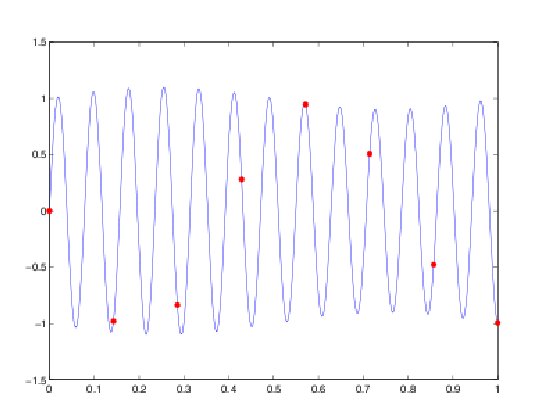
The significant new feature of this model is the introduction of the WKB approximation in the subband decomposition method. This allows the construction of an original finite element scheme, whose hat-functions are highly oscillating functions, permitting thus the choice of coarser grids.
Some results are presented in the sequel.
Schematic representation of the modeled DGMOSFET and the higly oscillating wave-functions
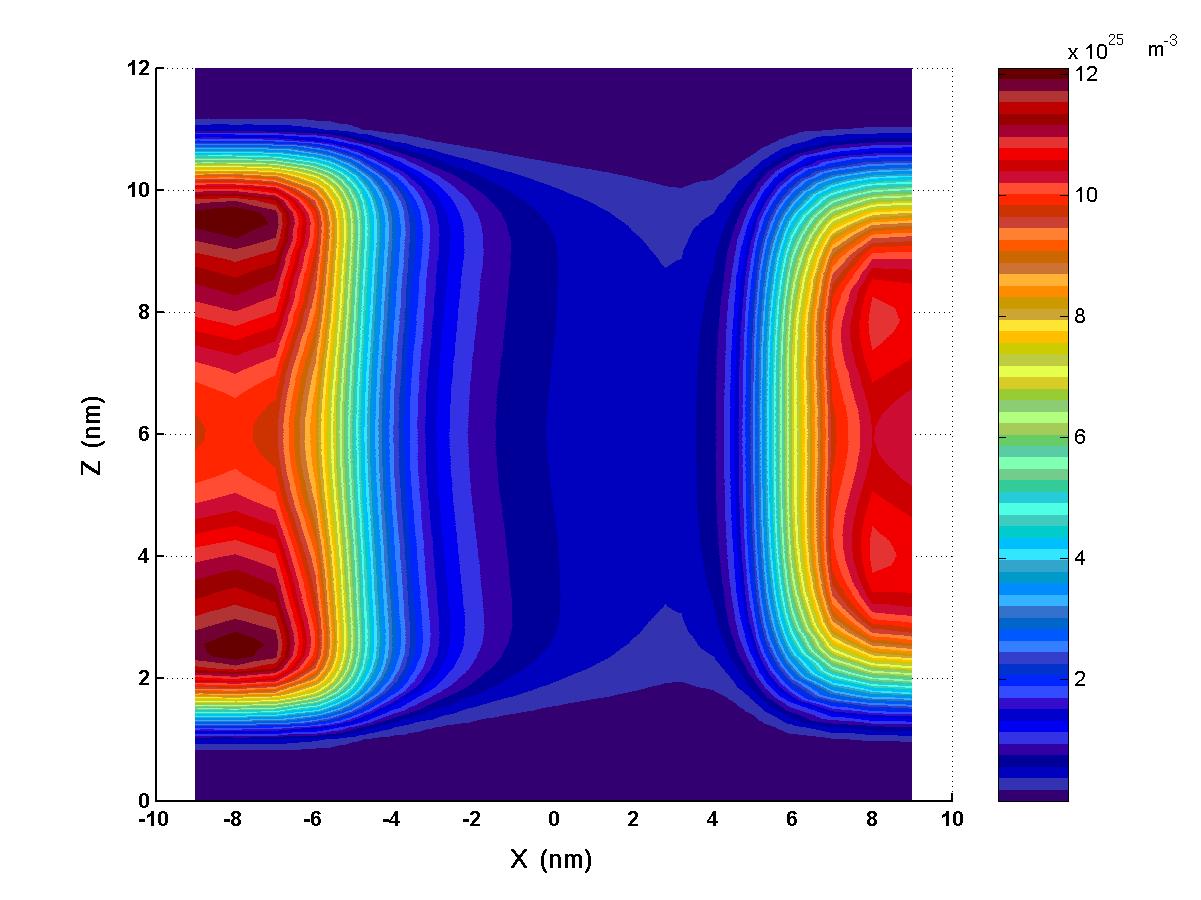
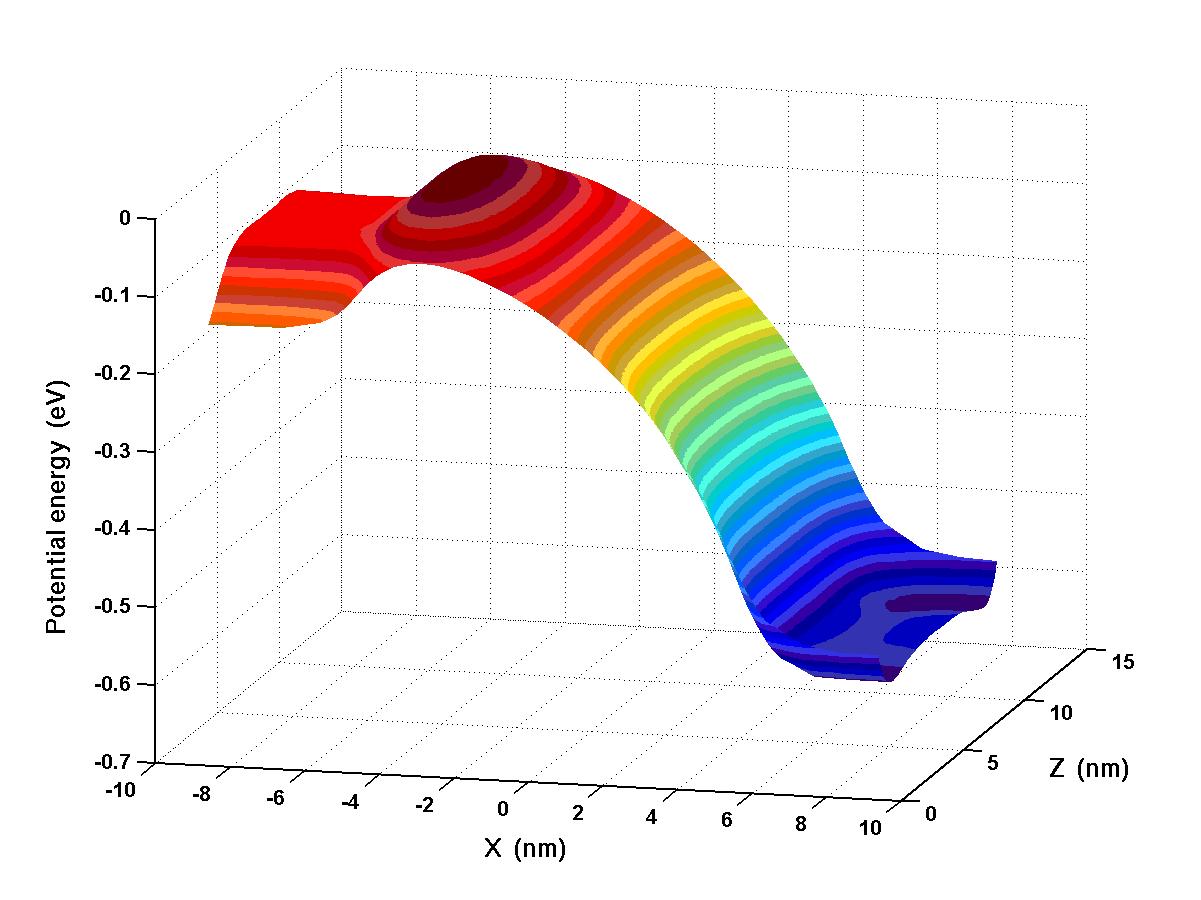
Electron density and potential energy for V_{DS}=0.5V and V_{GS}=0.1V
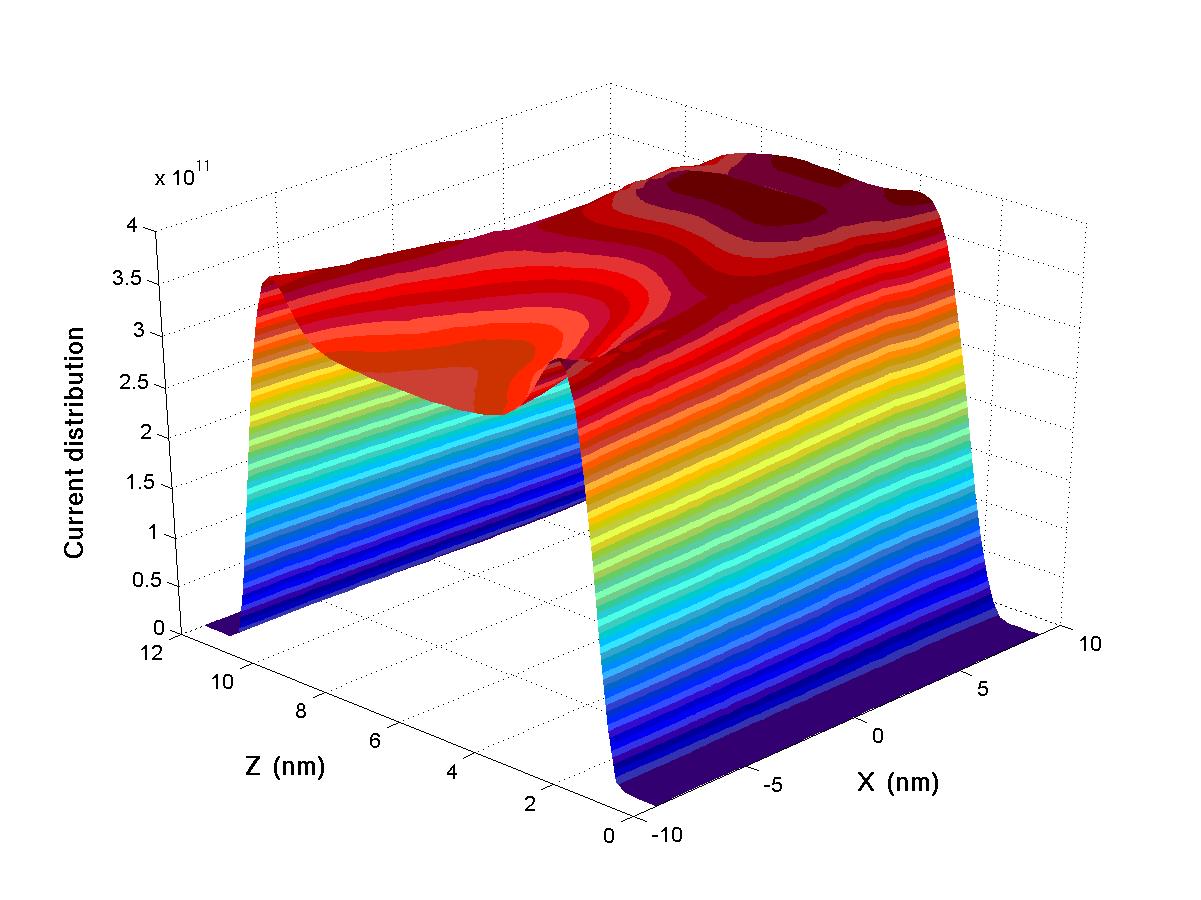
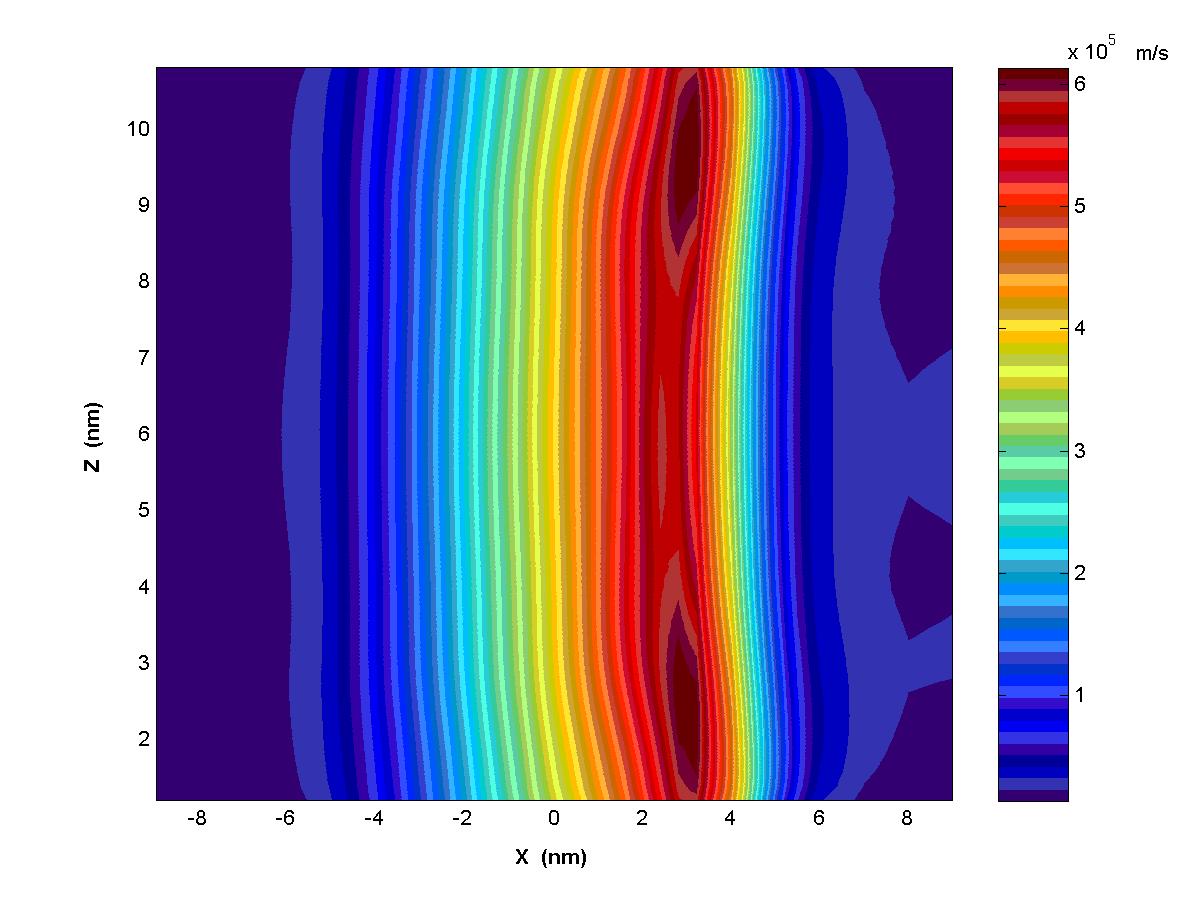
Current density and electron velocity for V_{DS}=0.5V and V_{GS}=0.1V
Simulation of decoherence effect :
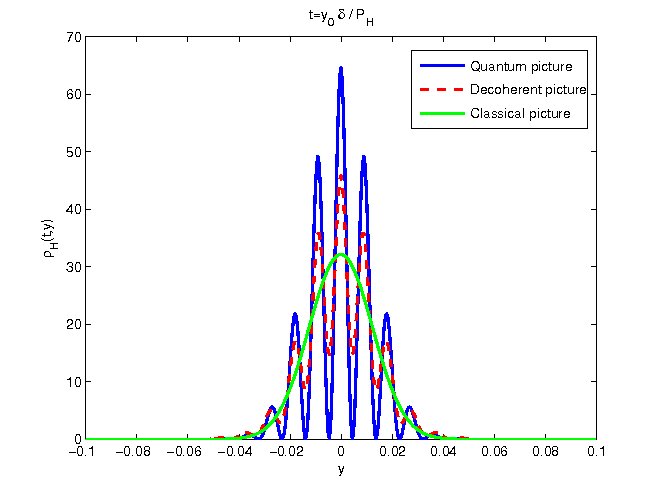
Quantum decoherence is judged to be the main reason of the emergence of a classical behavior in a physical system, which is normally correctly described by quantum mechanics. The most important features of the quantum world are the superposition principle and the entanglement. The observable characteristic of a quantum mechanical superposition state is the occurrence of interference fringes in the probability density associated to the state. However, the quantum coherence present in the unaffected superposition state is very fragile, even a weak interaction with the environment can destroy the interference pattern, in particular the phase relations between the different states in the superposition, and a classical behavior of the system emerges. This reduction or even suppression of the interference fringes in a quantum system, induced by the environment, is called decoherence effect.
The aim of the toy-model we conceived, consisting of the two-particle time-dependent Schr\"odinger equation, is to study numerically the mechanism of decoherence on the simplest model in which it takes place, that means a heavy particle (for example oxygen ions or protons) that scatters a light one (for example electrons or positrons). The two particles
interact with each other via a repulsive potential.
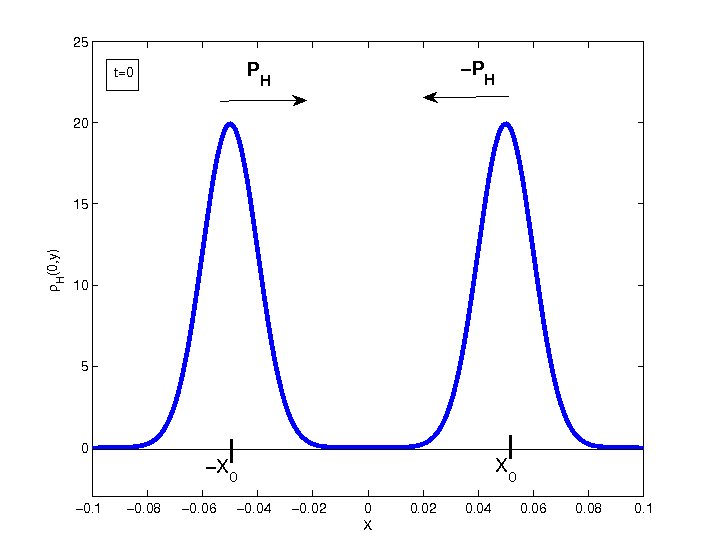
Left: Initially, the heavy particle is given under the form of two
wave-packets moving against each other.
Here is plotted the corresponding probability density. Right: Partially decoherent superposition of the two heavy particle bumps, at overlap time.
Asymptotic Preserving schemes:
The numerical resolution of highly anisotropic physical problems is a
challenging task. In particular, it is difficult to capture the
behaviour of physical phenomena characterized by strong anisotropic
features since a straight-forward discretization leads typically to
very ill-conditioned problems. In the class of problems addressed in
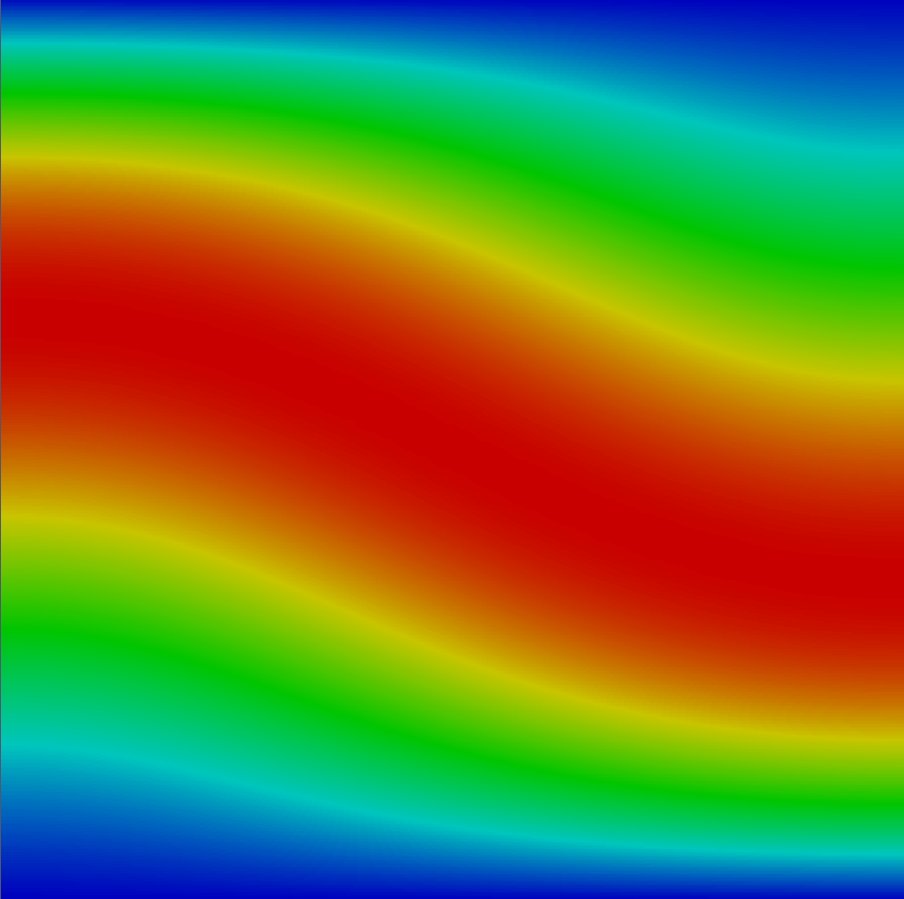
my research domain, the anisotropy is aligned with a vector field which may be
variable in space/time.
Variable anisotropy field b
Such problems are encountered in many physical
applications, for example flows in porous media,
semiconductor modeling, quasi-neutral plasma
simulations, magnetized plasma simulations, the list of possible applications being
not exhaustive.
The concern of my research work in this direction is the introduction of
very efficient Asymptotic Preserving schemes for the resolution of
highly anisotropic diffusion equations. The characteristic features
of thess schemes are the uniform convergence with respect to the small
anisotropy parameter $0<\eps <<1$, the applicability (on cartesian
grids) to cases of non-uniform and non-aligned anisotropy fields $b$
and the simple extension to the case of a non-constant anisotropy
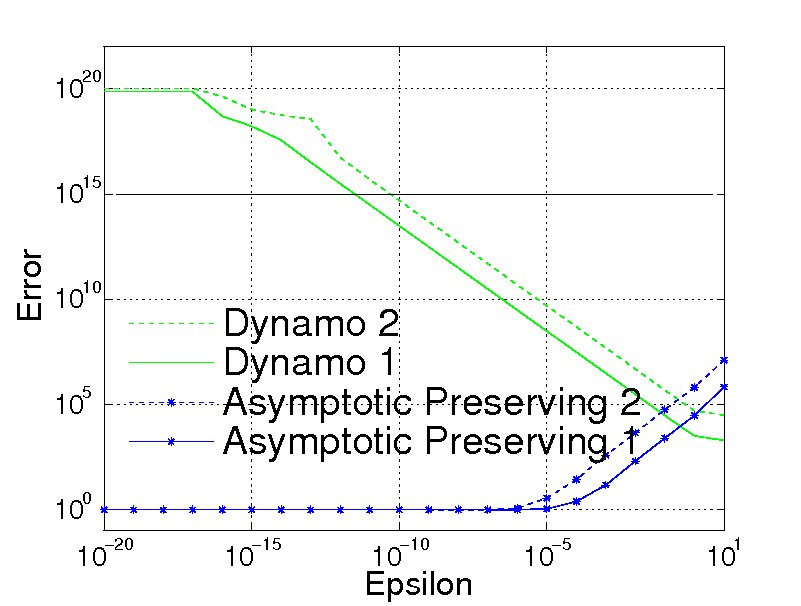
intensity $1/\eps$. The construction of such schemes is based on a mathematical reformulation of the problem, via a micro-macro decomposition of the unknown. The new AP-reformulation of the problem has the considerable advanatge of being well-posed in the limit $\eps \rightarrow 0$.
Left: Comparsion of the condition number of a standard scheme (Dynamo) and an AP-scheme.